

I am too busy to keep my website updated
I am too busy to keep my website updated
There is usually a moment when you notice it.
Someone asks what services you offer, and you hesitate before sending them to the website because one of the pages is out of date. A new testimonial arrives, but adding it gets pushed to next week. A service changes, a team member joins, an image needs replacing or a form needs checking, and each job gets added to a list that never quite reaches the top.
Not through neglect, laziness or lack of care.
You are running the business.
Clients need attention. Work needs delivering. Enquiries need answering. Staff, suppliers, accounts and everything else compete for the same limited time. Updating the website matters, but rarely feels as urgent as the thing happening directly in front of you.
The problem is that the website keeps representing the business whether you have had time to work on it or not.
Someone visiting today does not see the version you intend to update next month. They see the services, information, examples and enquiry routes that are there now. If those have gradually fallen behind the business, the website can start giving people an older or less complete picture of what you actually offer.
Relying on spare time alone therefore becomes difficult. A website needs some way to stay accurate, useful and aligned with the business while you are busy running it.
For some businesses, that simply means having practical help available for the updates, checks and smaller jobs that would otherwise keep being postponed. For others, the backlog can reveal that the website itself needs a little more attention.
The useful starting point is understanding what is actually getting in the way.
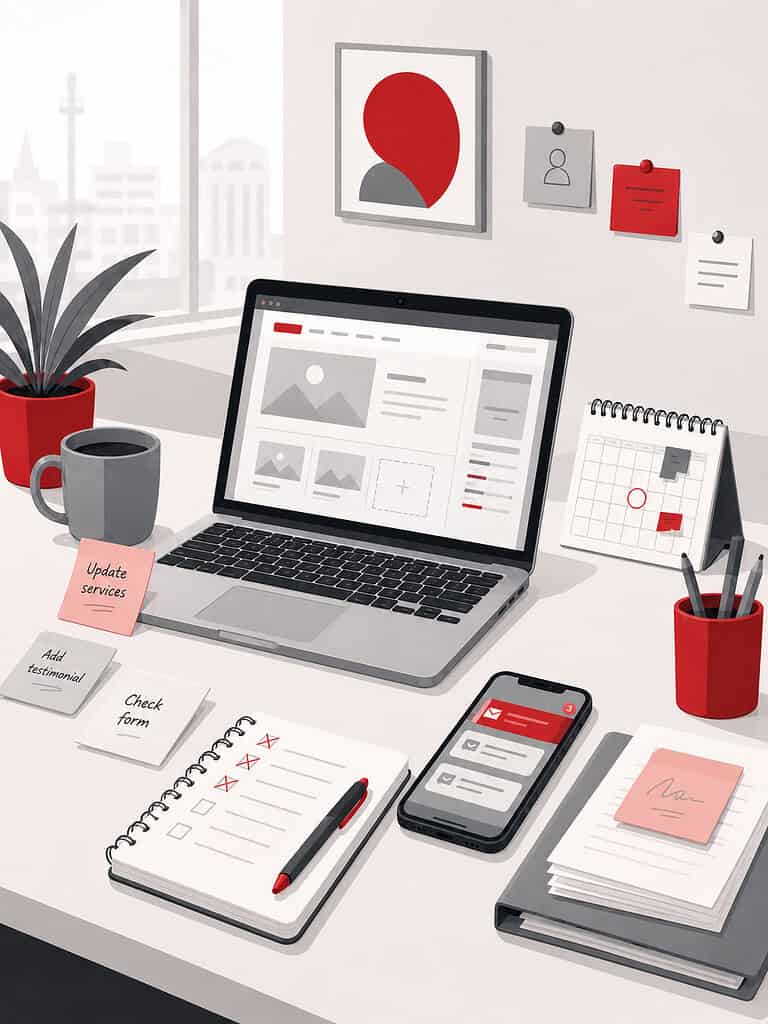
When the website becomes another job you have to carry
Most business owners do not need convincing that their website matters. They already know.
That is part of the frustration.
You know when a page feels old. You know when the wording no longer sounds like how you would explain the business today. You know when the images belong to an earlier stage, when the service list is incomplete, when a case study should have been added, or when the site no longer reflects the quality of work you are now delivering.
The difficulty is not always awareness. It is capacity.
Updating a website can sound simple from the outside. Change a sentence. Add a section. Swap an image. Publish a new page. But in practice, even small updates can become fiddly. You need to log in, find where the content lives, remember how the page was built, avoid breaking the layout, check how it looks on mobile, think about the SEO impact, test the form, clear the cache and hope nothing odd happens.
So the task gets delayed.
Over time, the delay changes the way you think about the site. Instead of feeling like a useful business tool, the website starts to feel like a low-level burden. Something you know needs attention, but not something you have the time, headspace or confidence to deal with properly.
That is where websites begin to lose value. Not because they were badly built, but because they are left to stand still while the business keeps changing around them.
What starts to slip when updates keep waiting
The effects of delayed website updates are rarely dramatic at first.
A service changes slightly, but the old explanation stays online. Your audience becomes clearer, but the wording still speaks to everybody. The way you work improves, but the process on the website describes how things used to happen. New projects, stronger testimonials and better examples of your work exist, but none of them have made it onto the site yet.
Individually, those things can feel minor.
Over time, though, they create distance between the business people encounter in real life and the one they meet online.
The website can start underselling services that have become stronger. Good work remains invisible. Useful proof sits in an inbox rather than on the page where somebody needs reassurance. Information that was once accurate gradually becomes less representative of the business.
Then there is what those delayed changes add up to from the visitor’s side.
A testimonial might sit waiting for months. A project you are proud of never appears. A form may stop behaving properly. An old image stays in place because replacing it feels like another job. A service page can continue explaining the offer as it was last year even though the way you deliver it has moved on.
None of those things always feels urgent on its own. Together, they can make the website feel less current than the business behind it.
Visitors do not know that the better explanation is still in your head, the new photographs are waiting on your computer or the form has been on your list for three weeks. They can only judge what is in front of them.
That is why delayed updates are not simply an admin backlog. Eventually they can affect how accurately the website explains the business and how much confidence somebody feels while deciding whether to contact you.
Why website updates are more than admin
Website updates are often treated as admin, but they are really part of how the business keeps communicating.
Your website is where many people check whether your business still feels like the right fit. It is where they compare what you say with what they need. It is where they look for reassurance before speaking to you. If the website is out of step, the visitor has to work harder to understand you.
An outdated service page can make a strong offer feel weaker than it is. Thin content can make expertise harder to recognise. Old project examples can make the business look less developed than it has become. Missing proof can leave visitors unsure whether you are the right choice. Unclear calls to action can mean people leave even when they were close to enquiring.
Technical care matters too. WordPress, themes, plugins, backups, security, speed, forms and mobile performance all sit behind the visible website experience. When these things are not looked after, the site can become slower, less reliable or more vulnerable over time.
So yes, this is about keeping the website updated. But underneath that, it is about keeping the website trustworthy, useful and representative of the business.




Finding the right level of website support
Not every busy business owner needs the same kind of help.
If the website is fundamentally working but updates keep being pushed back, Website Support & Maintenance Packages may be the right route. This gives the site a steadier place in the business, with practical support for updates, checks, technical care and the smaller improvements that are otherwise easy to postpone.
If the website is accurate in places but becoming thin, unclear or less convincing than the business itself, a website refresh may make more sense. That can improve content, structure, calls to action, proof and important pages without assuming the whole website needs replacing.
If the site has become difficult to manage, awkward to expand or too far behind the business it now represents, a website redesign may be the stronger route. In that situation, the problem is no longer just a backlog of updates. The website itself may be making those updates harder than they need to be.
And if you cannot tell which of those situations you are in, a website review can help before you commit to a particular route.
After more than 20 years of working with websites, one thing we have learned is that the length of the website to-do list does not tell you how large the solution needs to be.
A long list of straightforward changes can sometimes be dealt with perfectly well through ongoing support. On another website, repeatedly struggling with what should be simple updates can reveal deeper problems with the structure, platform or way the site has evolved.
Getting help should make that easier to deal with, not create another system for you to manage. It might mean having somewhere to send smaller content changes when a service evolves, a testimonial arrives or an image needs replacing. It might mean technical updates and checks being looked after in the background. It can also mean having somebody investigate a problem before you lose an afternoon trying to work out whether it sits with the content, WordPress, a plugin, the hosting or something else.
That is where experience becomes useful. We can look at what the website needs to do for the business, what visitors need to understand and what is actually making it difficult to keep current. A small job can stay a small job. Several related changes can be considered together. And if a recurring problem suggests something deeper, we can explain that rather than continuing to patch around it.
For businesses around Tamworth and the surrounding area, that can also mean having somebody nearby who understands the wider website rather than treating each request as an isolated technical task. Much of the practical support itself can still be handled remotely.
The useful question is not simply, “How much needs changing?”
It is, “Why is this website becoming difficult to keep current, and what level of help would actually remove that problem?”
The right route should give the website enough attention to stay useful without making the solution bigger than it needs to be.
If your website keeps being pushed down the list
Being too busy to update your website is normal. It usually means you are dealing with the real demands of running a business.
But the website is still representing that business while your attention is elsewhere. Leaving every update, check and improvement until spare time appears makes it very easy for the site to keep falling behind.
If that sounds familiar, take a look at our Website Support & Maintenance Packages. They provide a practical route for keeping the website maintained, updated and useful without leaving every smaller job on your own list.
You do not need to work out exactly what level of support you need first. If the website needs something different, we can help you identify that before making the solution bigger than it needs to be.