

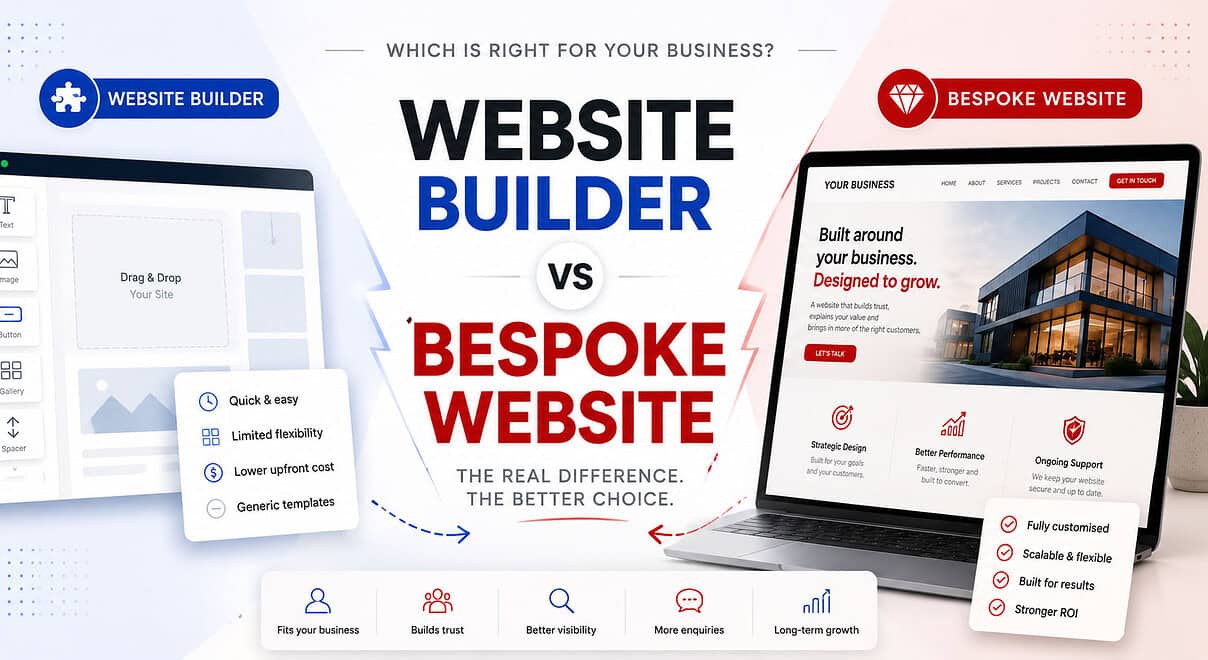
Choosing how to build your business website is not always as simple as choosing between cheap and expensive.
For many small businesses, the question feels practical at first. Should you use an online website builder and create something yourself, or should you work with a web designer to create a more tailored site? One route can look quicker and more affordable. The other can feel more considered, flexible and professional. Both have a place, but they do not serve the same kind of business need.
The real question is not only “how much will it cost?” It is “what does this website need to do for my business?”
A website is often where people decide whether your business feels credible, clear and worth contacting. It may be the first place they check after hearing your name. It may be where they compare you with other providers. It may be where they decide whether you look established enough, professional enough or relevant enough for what they need.
That means the route you choose should depend on the role your website needs to play. A simple site builder may be enough for some businesses at an early stage. A bespoke website may make more sense when the site needs to communicate more clearly, support enquiries, reflect a stronger brand or grow with the business over time.
Why this decision matters
Most business owners do not wake up excited about website platforms.
They usually reach this decision because something else is happening. They are starting a business and need to look credible. They have relied on social media for a while and now want something more stable. Their old website no longer reflects the business. They are missing enquiries, struggling to explain their services or feeling unsure about whether a DIY route will be enough.
That uncertainty is understandable. Online site builders are visible, accessible and heavily advertised. They promise speed, simplicity and low monthly costs. For a business owner who wants to get something online without a large upfront project, that can be appealing.
At the same time, a website is not just a collection of pages. It is part of how people understand your business. It shapes first impressions, supports trust, guides visitors towards the right information and helps people decide whether to take the next step.
If the website only needs to act as a very simple online presence, a site builder may be enough. If it needs to work harder than that, the decision deserves more thought.
When an online site builder can make sense
Website builders have improved a lot over the years. For some businesses, they can be a perfectly reasonable starting point.
If you are testing an idea, working with a very small budget or need a basic online presence quickly, a site builder can help you create something without going through a full design process. You may be able to choose a template, add your logo, write your own content and publish a few simple pages.
That can work for a business that only needs the basics: who you are, what you offer, where you are based and how people can contact you. It may also be useful if your website is not yet a major part of your enquiry journey, or if you simply need somewhere to point people while the business is still taking shape.
There is nothing wrong with starting simply. Not every business needs a large website from day one.
The danger comes when a site builder is expected to do a job it was never really designed to do. A basic template can give you a presence, but it may not give you the clarity, flexibility, structure or confidence you need as the business becomes more serious about how it appears online.
The hidden limits of doing it yourself
The challenge with DIY website builders is rarely the first few hours.
At the start, the process can feel straightforward. You choose a design, swap in some text, upload a few images and adjust the colours. The difficult part usually appears later, when the website needs to behave like a proper business tool.
You may start to wonder whether the homepage explains the business clearly enough. You may need service pages that do more than list what you offer. You may realise the layout looks fine on desktop but feels awkward on mobile. You may struggle to make the site feel distinctive rather than template-led. You may want better SEO foundations, stronger calls to action, clearer navigation or more flexibility than the builder gives you.
There is also the time cost. A site builder may reduce financial cost, but it often moves more of the thinking, writing, design, layout, testing and decision-making onto the business owner. For some people, that is fine. For others, it becomes a slow drain on time and confidence.
The website may technically exist, but still not quite say what it needs to say.
What a bespoke website adds
A bespoke website should not just mean “a prettier website”.
The value of a custom-made website is that it can be shaped around the business, the audience and the job the website needs to do. It can be planned from the ground up instead of squeezed into a template that was designed for thousands of different businesses.
That matters because two businesses in the same industry can still need very different websites. One may need to explain a specialist service clearly. Another may need to show trust and proof because the buying decision is more cautious. Another may need booking, ecommerce, forms, downloads, automation, gated resources, local SEO pages or a content structure that can grow over time.
A bespoke website gives more room to make those decisions properly.
The design can reflect the business rather than simply filling a template. The copy can be written around the questions visitors are likely to have. The page structure can guide people towards the right services. The technical setup can be considered from the start. The site can be built with future growth in mind rather than becoming boxed in as soon as the business needs something more.
Good bespoke website design is not about adding complexity for the sake of it. It is about creating the right foundation.
Functionality matters when the website has a real job to do
A simple brochure website may not need much technical functionality. But many business websites eventually need to do more than sit online.
You may want people to book appointments, request quotes, complete forms, buy products, download resources, make payments, join a mailing list, access gated content or interact with your business in a more structured way. You may need integrations with email marketing, CRM tools, booking systems, analytics, payment gateways or automation tools.
Some website builders can handle parts of this, but the experience often depends on the platform, the plan and the level of control available. You may find yourself working around the system rather than shaping the system around your business.
With a bespoke website, functionality can be planned around the way your business actually works. That does not mean building everything at once. It means the website can be created with a clearer understanding of what you may need now, what can wait, and what should be possible later.
This is especially important for growing businesses. A website that feels convenient at the start can become frustrating if it cannot support the next stage.
Design is about trust, not just appearance
People make quick judgements online.
They may not consciously analyse your website, but they notice how it feels. They notice whether the design looks current, whether the wording is clear, whether pages are easy to move through, whether the business feels real, and whether the overall experience gives them confidence.
A template website can look tidy, but it can also feel familiar in the wrong way. If the layout, imagery and structure look like many other sites, the business may struggle to feel distinctive. That is not always a disaster, but it can matter in competitive local markets where several businesses offer similar services.
Bespoke design gives more control over how the business is presented. It allows the website to reflect the tone, personality, quality and positioning of the brand. It also allows design decisions to support the visitor journey, not just the visual style.
For example, a strong homepage is not just about looking impressive. It should help visitors understand what you do, who you help, why they can trust you and where they should go next. A service page is not just a place to describe an offer. It should help someone understand whether that service is right for their situation.
That is where professional design becomes more than decoration.
SEO is easier when the website is built with structure in mind
A website needs to be findable as well as presentable.
Site builders often include basic SEO settings, such as page titles, meta descriptions, image alt text and simple URL controls. For a small site, that can be helpful. But SEO is not only about filling in a few boxes.
Search visibility depends on the structure and usefulness of the site. It depends on whether each page has a clear purpose, whether the content matches what people are searching for, whether the site loads well, whether it works properly on mobile, whether pages are internally linked, and whether search engines can understand the relationship between your business, services and location.
A bespoke website can be planned with SEO in mind from the start. That means thinking about service pages, local relevance, content structure, technical foundations, page speed, schema markup, headings, internal links and the kind of search intent each page needs to satisfy.
This is not about trying to trick Google. It is about making the website clearer for both search engines and visitors.
For a small business, that clarity can make a real difference. A website that explains the business properly is more likely to support the right enquiries than one that simply exists.
Performance and ownership are worth considering
Website performance affects how people experience your business.
If a website is slow, awkward or unreliable, visitors may leave before they have fully understood what you offer. If it is difficult to update, the business owner may avoid making changes. If it relies heavily on a closed platform, moving away later may be harder than expected.
This is where ownership matters.
With many online site builders, your website is tied to the platform. You may be paying monthly for access to the system, hosting, templates and tools. That can be convenient, but it can also limit control. If the platform changes pricing, features or restrictions, you may have fewer options. If you want to move the site elsewhere, you may not be able to take everything with you in a clean way.
A professionally built website, especially on a flexible platform such as WordPress, can offer more long-term control. You can choose hosting, extend functionality, improve performance and develop the site over time.
That does not automatically make every bespoke website better. A poorly built custom website can still be slow, hard to manage or overcomplicated. The point is that the build route should support the business’s long-term needs, not just the easiest launch.
Cost is not only the upfront price
Cost is often the biggest reason businesses consider a site builder.
That makes sense. A DIY platform can look much cheaper at the beginning, especially if the business is new or cash flow is tight. But cost should be looked at in context.
A site builder may save money upfront, but it may cost time. It may also create limitations that become more expensive later if the site needs to be rebuilt, redesigned or migrated. If the website does not explain the business clearly, does not generate enquiries, or makes the business look less established than it is, there is also an opportunity cost.
A bespoke website usually requires a larger investment, but it should provide more strategic value. You are not only paying for pages to be built. You are paying for planning, structure, design judgement, technical setup, content support, SEO awareness, user experience and guidance.
The right choice depends on where the business is now.
For a very early-stage business, the most sensible route may be a simple starter site. For an established business, a growing business or a business that relies on its website for credibility and enquiries, a bespoke route may be the better long-term investment.
The cheapest website is not always the most cost-effective one.
A site builder may be enough if the website is low-risk
There are situations where a site builder may be perfectly reasonable.
If your website is not central to how people choose you, if you only need a simple temporary presence, or if you are still testing a business idea, a DIY route can help you get started. It can also be useful for people who enjoy working on their own content and are comfortable managing design decisions themselves.
The key is to be honest about the risk.
If a basic website does not reflect your business perfectly, does that matter right now? If it feels a little limited, will that hold you back? If it does not perform well in search, do you have other routes to enquiries? If the design looks template-based, will that affect trust?
For some businesses, the answer may be no. For others, those small issues can add up quickly.
A bespoke website makes more sense when trust and clarity matter
A bespoke website becomes more valuable when the website needs to carry more responsibility.
If visitors are comparing you with other businesses, the website needs to help you feel credible. If your services need explanation, the website needs to make them clear. If your brand has moved on, the website needs to reflect who you are now. If enquiries matter, the journey needs to guide people towards action. If local visibility matters, the structure needs to support search.
This is where a custom-made website usually makes the stronger case.
It gives you the opportunity to build the site around the real decision your visitors are making. It allows your content, design, navigation, SEO foundations and functionality to work together rather than sitting as separate pieces.
That is the difference between having a website and having a useful digital foundation.
The right choice depends on what your website needs to become
There is no single right answer for every business.
An online site builder can be a sensible starting point when the need is simple, the budget is tight and the website does not yet carry a major commercial role. A bespoke website is usually the better route when the site needs to support trust, explain the business properly, improve enquiries, reflect a stronger brand or grow with the organisation.
The important thing is not to choose based only on the easiest way to get online.
Choose based on what the website needs to help people understand. Choose based on how much confidence it needs to create. Choose based on whether your business needs a temporary presence or a stronger long-term foundation.
For some businesses, a simple site builder is enough for now. For others, it quickly becomes the thing they outgrow.
Making a confident decision
A website should make your business easier to understand, easier to trust and easier to choose.
If a site builder can do that well enough for where your business is right now, it may be a practical first step. If your website needs to do more — support enquiries, communicate value, reflect your brand, improve search visibility or grow with the business — a bespoke website is likely to offer more value over time.
The decision does not need to be rushed or overcomplicated. It simply needs to be made with the right question in mind:
What does this website need to do for the business, the visitor and the next stage of growth?
If you are unsure which route makes sense, Expand Digital Media can help you look at the options clearly. Whether you need a simple website package, a pay-monthly route, a redesign or a more bespoke website, the right starting point is understanding what your website actually needs to achieve.
