

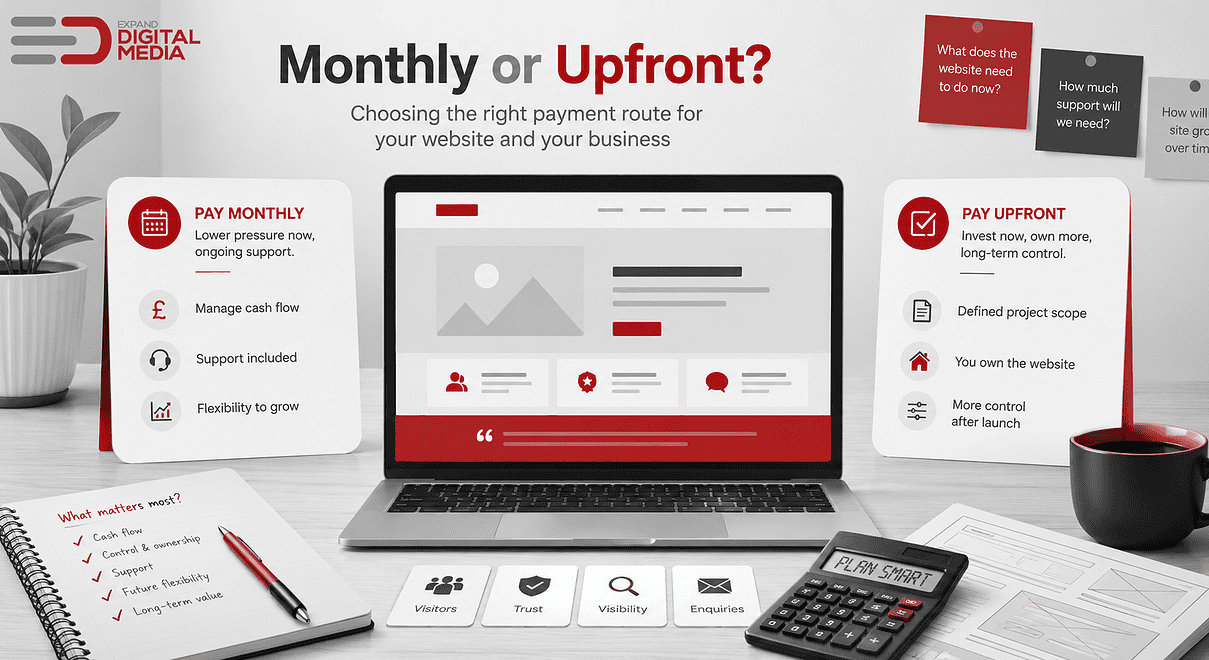
You can look at two website options and still not feel any closer to making a decision.
One says you can pay monthly. The first payment feels manageable, and the support may be included. That can feel like a relief, especially when the business has other costs competing for attention.
The other asks for more money upfront. That can feel heavier, but also cleaner. You know what the project costs, you know what is being built, and you may feel more in control once the website is live.
On paper, it looks like a payment choice.
In reality, it is usually a business judgement about pressure, commitment, control and what the website now needs to do.
That is why the cheapest-looking option is not always the safest one. A monthly website can be sensible. An upfront website can be sensible. Both can also become frustrating if the route does not fit the business behind it.
The better question is not simply:
Should I pay monthly or upfront?
It is:
Which route gives the business the website it actually needs, at a level of pressure it can sensibly carry?
That matters because a website is not just something a business gets online. It is often where people check whether the business feels credible enough to contact. They may have already heard your name, seen your work, found you through Google, clicked from social media or been given a recommendation. The website is where they decide whether everything feels clear, current, trustworthy and easy enough to act on.
So the payment route should not be treated separately from the job the website has to do.
A simple launch website, a more developed service-led website, an ecommerce site, a redesign, a booking-led website and a content-led website all carry different demands. They need different levels of thinking, structure, support and flexibility. The right payment route depends on the business decision underneath the website.
The first price is only part of the decision
It is natural to compare the first visible numbers.
Monthly usually looks easier at the start. Upfront usually looks heavier.
That comparison is not wrong, but it is incomplete.
For a new or smaller business, protecting cash flow can be a sensible commercial decision. There may be other priorities competing for the same money: stock, equipment, rent, insurance, staff, marketing, software or simply the need to keep some breathing room in the business. In that situation, a lower starting cost can make a website possible without creating unnecessary strain.
But lower starting cost does not always mean lower risk.
A monthly website still creates a commitment. The business needs to understand the full term, the total cost, what is included, what happens if the business changes, and what control it has over the website during and after the agreement.
The same applies in reverse. Paying upfront can feel more expensive at the beginning, but it may give the business a cleaner project, more control and fewer ongoing obligations. That can be useful when the business has the budget available and wants the website planned, built and owned as a defined asset.
But upfront does not automatically mean better value.
A low upfront price can create its own problems if the project is under-scoped. A website can be designed neatly and still fail to explain the business properly. It can have the right number of pages and still lack the service detail, proof, enquiry route or local search structure that would help visitors make a confident decision.
That kind of website does not usually fail loudly. It just underperforms quietly.
People land on it, look around, hesitate and move on. The business may not know whether the issue is design, copy, structure, trust, search visibility or simply that the website was never given enough room to do the job expected of it.
The real comparison is not monthly versus upfront as payment labels.
It is the level of website, control, support and flexibility each route gives you for the pressure it creates.
When paying monthly can be the stronger route
Pay monthly website design can make good sense when the business needs a credible website but does not want to pull a larger amount of money out of the business straight away.
This is often true for startups, sole traders and smaller local businesses that need to look established before income is fully predictable. They may need a professional place to send people, a clearer way to explain their services, a stronger first impression than social media alone can provide, and a route for enquiries that feels more reliable than messages scattered across platforms.
In those cases, waiting until the perfect upfront budget is available can hold the business back. It can mean staying with no proper website, relying on a weak one for too long, or continuing to send people to a digital presence that does not match the standard of the work.
A monthly route can move the business forward sooner.
That matters because a website is not only useful after someone searches for you. It also supports referrals, local conversations, networking, social posts, email signatures, Google Business Profile activity and everyday confidence. When someone asks where they can find more information, the business has somewhere credible to send them.
Monthly can also be the better route when ongoing support is part of the value.
Some business owners do not want to manage hosting, updates, backups, plugin changes, security checks, small edits or layout fixes. They may be perfectly capable in their own business but have no desire to become the person responsible for keeping the website healthy. Others know from experience that if support is not built in, updates will be postponed until the site starts to feel stale.
In that situation, monthly is not just a payment plan. It is a way of reducing the ongoing management burden.
The caution is that a monthly website should make the business feel clearer, not trapped.
Before agreeing, it is worth understanding how long the arrangement lasts, what happens at the end of the term, what the business owns, whether the website can be moved, what support is included, how changes are handled and what happens if the business needs more pages, new functionality or a different level of website later.
Monthly works best when the commitment is clear and the support is useful.
It works less well when the lower starting cost hides inflexible terms, limited ownership or a website that cannot grow with the business.
When paying upfront can be the stronger route
Paying upfront often makes more sense when the business has the budget available and the website needs more depth from the start.
This is common when the business has moved beyond its first version.
The current website may have been fine at one stage, but the business has changed. The services may be more developed. The work may be stronger. The audience may be more specific. The business may have better proof, better photography, stronger reviews or more experience than the website currently shows.
At that point, the website is not just a presence. It is part of how the business is being judged.
An upfront project can give more room for the work behind the visible design: planning the structure, shaping service pages, writing clearer copy, improving calls to action, organising proof, considering local SEO, improving forms and thinking about how different visitors move through the site before they enquire.
That kind of thinking matters because website quality is not only about how polished the homepage looks. A visitor may need to understand whether the business handles their kind of problem, whether the service is suitable, whether the company looks active, whether the work feels credible, whether the process is clear and whether the next step feels low-risk enough to take.
A stronger upfront project can give those decisions more space.
It can also suit businesses that want clearer ownership and fewer bundled commitments. Once the website is built, ongoing hosting, maintenance and support can be chosen separately. That separation may feel cleaner for a business that wants control over the asset and flexibility over how it is managed after launch.
But paying upfront only works well when the scope is realistic.
If the budget is squeezed too hard, the project can lose the very things that would make the website useful. The page count may be reduced before anyone has worked out what visitors need to understand. Copy may be rushed. Service detail may be kept too thin. Proof may be added as an afterthought. The design may look fine, but the website may not carry enough explanation to support trust or enquiries.
A smaller upfront website is not automatically a problem. Plenty of businesses only need a focused, well-made site.
The problem is when the website needs a deeper job done, but the project has been reduced to fit the lowest possible upfront price.
The trade-off is not cost; it is pressure and control
The most useful way to compare monthly and upfront is to look at the type of pressure each route creates.
Pay monthly usually lowers the pressure at the beginning but creates a longer commitment.
Paying upfront usually creates more pressure at the beginning but can reduce ongoing obligation later.
Neither is automatically better. The question is which pressure is healthier for the business at this stage.
Take a new local service business. The owner may need a credible website quickly because people are already asking where they can find more information. They may have other costs to manage, and the website only needs to create a strong first impression, explain the service clearly and make enquiries easier. In that situation, a monthly route could make sense. It protects cash flow, gets the business moving and may include the support needed while the business settles.
Now take a more established business with an older website. The company may have better projects, stronger proof and more developed services than the site currently shows. The issue is not simply that the website exists or does not exist. It is that the website is underselling the business. In that case, paying upfront for a more considered project may be the stronger route because the work needs more planning, more structure and more attention to how visitors decide whether to enquire.
Support can change the decision again.
One business owner may prefer monthly because they want the website looked after and do not want to think about hosting, updates, small changes or technical maintenance. Another may prefer upfront because they want to own the project cleanly, avoid a longer agreement and choose support separately.
Control matters here.
A business should understand how much freedom it has to change the website, extend it, move it, access it, update it or separate from the provider in the future. Control does not mean the business has to do everything itself. It means the business understands what it can do, what the provider handles and what happens if circumstances change.
That is where a website payment decision becomes a business decision.
You are not only choosing how to pay. You are choosing how much flexibility, support and ownership you want around an asset that may become central to how people find, understand and contact the business.
What the website needs to do should lead the payment decision
The payment route should come after the website’s job is understood, not before.
That matters because “a website” can mean very different things depending on the stage of the business. For one business, the website may need to create a credible first impression and give people enough confidence to make contact. For another, it may need to explain several services, support local search, handle bookings, sell products, generate enquiries, show proof or help reposition the business as it grows.
Those are different jobs. They need different levels of structure, content, support and flexibility.
A new business may not need a large website straight away. It may need a focused, professional starting point that explains what the business does, reassures early customers and gives the owner somewhere credible to send people. In that situation, paying monthly may make sense if it protects cash flow and includes support while the business settles.
A more established business may be in a different position. The website may already be influencing how people judge the company. If the site no longer reflects the quality of the work, the range of services or the type of customer the business wants to attract, the issue is not just getting online. It is correcting the gap between the business as it is now and the business the website presents. That may justify an upfront project with more room for planning, copy, structure and proof.
A business with regular updates has another need again. If services change often, projects need adding, reviews need using, blogs are part of the plan or seasonal offers matter, the payment route should take ongoing support seriously. A cheaper build can become awkward if every change feels difficult, slow or uncertain.
A business that wants room to grow should also think beyond launch. The first version of the website does not need to include everything, but it should not make future growth harder. Adding pages, improving SEO, introducing ecommerce, changing forms, publishing case studies or building out service content should feel like a natural next step, not like starting again.
This is why the decision is not simply monthly for small budgets and upfront for bigger ones.
Pay monthly may be the stronger fit when the business needs a credible starting point, wants to protect cash flow, values support and is comfortable with a clear ongoing commitment.
Upfront may be the stronger fit when the business needs deeper planning, clearer ownership, more flexibility or a more developed website from the beginning.
There may also be a middle ground. A business might pay upfront for a focused first version and add maintenance afterwards. It might start monthly because support and cash flow matter now, then review the site once the business has grown. It might choose a smaller upfront project, but only if the structure allows sensible expansion later.
The payment method should not become the strategy.
The strategy is to understand what the website needs to do for the business, for the visitor and for the owner. Once that is clear, the right payment route becomes easier to judge.
What to understand before agreeing to either route
Before choosing monthly or upfront, the important details should be clear enough that you know what you are committing to, not just what the website will cost.
The first thing to understand is scope. A website proposal should explain what is actually being created: how many pages are included, what level of design work is involved, whether copywriting is included, how forms are handled, whether basic SEO foundations are covered and what happens if the site needs more content than first expected.
This matters because two websites with the same number of pages can involve very different amounts of work. A five-page website for one business may be a simple, credible presence with a homepage, a few service pages and a contact form. For another business, those same five pages may need careful service explanation, stronger proof, local SEO thinking, enquiry routing, booking logic or clearer routes for different types of visitor.
The next thing to understand is ownership. With an upfront project, ownership is usually expected, but it should still be confirmed. With a monthly website, ownership can vary depending on the agreement. The business should know what it owns, what access it has, whether the website can be moved and what happens if the relationship ends.
Support is just as important. Some website routes include ongoing help; others finish once the site is live. Neither is automatically wrong, but the business should know what happens after launch. If a service changes, a new review comes in, an image needs replacing or the enquiry form needs adjusting, is that included, charged separately or left for the owner to manage?
Future flexibility is the final piece. A website does not have to do everything on day one, but it should not block the business from growing. If the business may add services, publish case studies, improve SEO, introduce booking, sell online or build out more content later, the website should be structured with that possibility in mind.
These details usually tell you more than the headline price.
A good website route should leave you clear on what is being built, what happens after launch, what control you have and how the site can adapt as the business changes. If those answers are vague, the payment option may feel attractive at first but become harder to live with later.
Ownership and support can affect the long-term value
Ownership and support rarely feel like the most exciting parts of a website decision at the beginning.
They often become important later.
A website holds more than design files and pages. It may hold service information, enquiry routes, blog posts, images, reviews, tracking, landing pages, local search value, customer trust signals and the clearest public explanation of what the business does. If the business depends on the website, it should understand what control it has over that asset.
Ownership is not only about whether the business technically “has a website”. It is about knowing what belongs to the business, what access is available, what can be moved, what is tied to the provider and what happens if the relationship ends.
Support is about what happens once the website is live.
This is where many websites start to drift. Services change. Prices change. Staff change. Better project photos become available. Reviews build up. A business adds a new offer. A page that made sense at launch no longer reflects how the business works.
Without support, small updates can sit in the background for months. With unclear support, the owner may still hesitate because they do not know what is included or whether each change will become a new conversation about cost.
A good website route should therefore be judged beyond launch.
Getting the site live matters. Keeping it useful matters just as much.
There is no universal winner
There is no single right answer between paying monthly and paying upfront for a website.
The right route is unique to the business, because every business is making the decision from a slightly different place. One may be trying to get a credible first website online without putting too much pressure on cash flow. Another may be replacing an older site that no longer reflects the quality of its work. Another may need ecommerce, bookings, stronger service pages, better local visibility or ongoing support because the owner knows the website will not be managed internally.
That is why the decision should not be reduced to “monthly is easier” or “upfront is better value”.
Pay monthly can be the stronger route when the business needs a professional website sooner, wants to protect cash flow and values support being built into the arrangement. It can work well when the commitment is clear, the ownership position is understood and the website has enough flexibility to grow.
Paying upfront can be the stronger route when the business has the budget available, needs a more defined project and wants deeper planning, clearer ownership or fewer long-term commitments. It can work well when the website needs more thought around structure, copy, proof, enquiry flow and how visitors decide whether to take the next step.
The key is to look beyond the first number and think about the full decision.
What does the website need to do now?
What might it need to do later?
How important is cash flow?
How much control do you want?
How much support will you realistically need?
What happens after launch?
Will the site be able to grow with the business?
Those questions matter more than the payment label.
A useful website should help people understand what the business does, trust what they see and feel confident taking the next step. The payment route is only right if it helps the business get a website capable of doing that job, without creating the wrong kind of pressure around it.
If you are unsure which route fits, that is completely normal. Most business owners are not just choosing between two prices; they are trying to work out what level of website, support and commitment makes sense for where the business is now.
At Expand Digital Media, we help small and growing businesses talk through that decision before jumping straight into a package or project. A website review and chat can help you understand what your website needs to do next, what kind of route may fit, and whether monthly or upfront feels like the more sensible way forward.
