

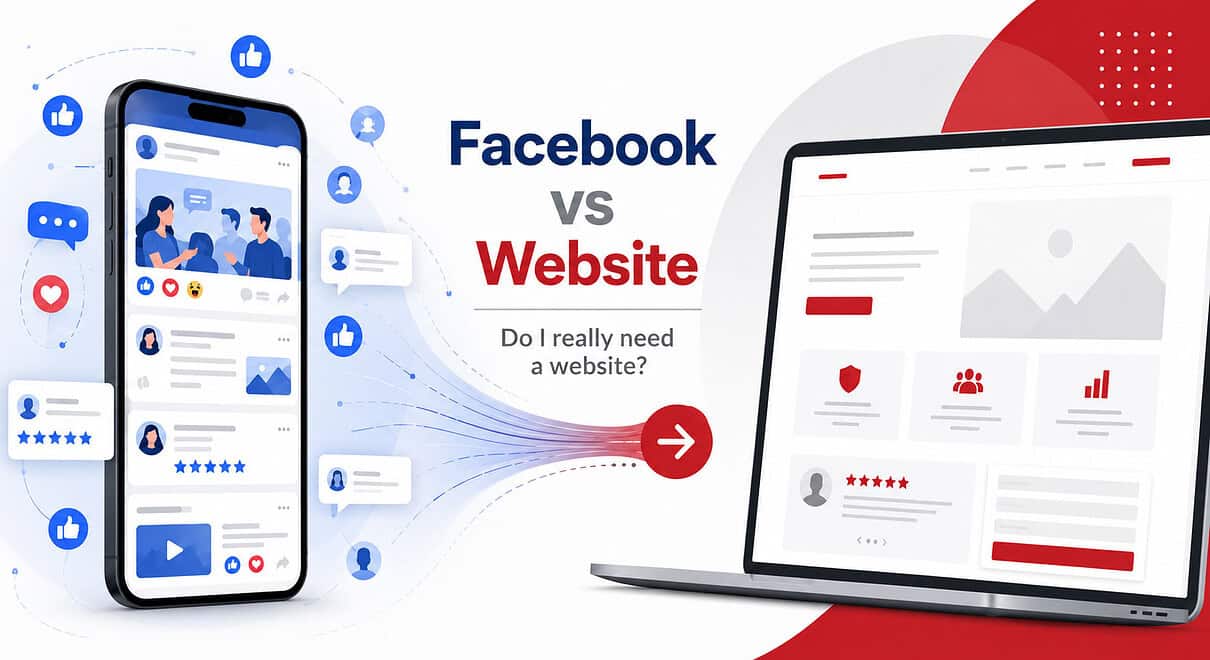
For many small businesses, Facebook feels like the easiest place to start online. It is familiar, quick to set up and simple to keep active. You can post updates, share photos, reply to messages, collect reviews and show that your business is doing something without needing to think about hosting, page structure, SEO or website maintenance.
So it is understandable why the question comes up: if people can already find your business on Facebook, send a message, read reviews and see recent activity, do you really need a website?
In most cases, yes.
A Facebook business page can be useful, but it should not be expected to do the whole job. Facebook can help people notice your business. Your website gives interested visitors a clearer place to understand what you offer, judge whether it fits them and decide what to do next.
Why Facebook can feel like enough
Facebook gives small businesses something immediate. A café can share daily specials, opening hours and last-minute table availability. A tradesperson can post recent work and receive recommendations in local groups. A charity or community organisation can promote events, campaigns and volunteer updates. For businesses that rely on regular updates, visibility and local familiarity, Facebook can be genuinely valuable.
It can also help you reach people who were not actively looking for you. A post might be shared by an existing customer. Someone might tag a friend in a recommendation thread. A paid advert might appear in front of people nearby. Those moments can create awareness, especially for businesses that depend on word of mouth, community activity or repeat local visibility.
But awareness is not the same as understanding.
Most people use Facebook while they are browsing. They are scrolling through family updates, local group posts, videos, adverts, opinions, memories and distractions. Your business may appear in front of them, but it appears inside a busy feed where attention moves quickly.
Facebook can spark interest. It is not always the strongest place to turn that interest into a confident enquiry.
The difference between being seen and being chosen
There is a gap between someone seeing your business and someone feeling ready to contact it.
A person might notice a builder’s Facebook post showing a finished extension, but before asking for a quote they may want to know what kind of projects the business takes on, which areas are covered, how the process works and whether there are more examples of similar work. Someone might see a therapist recommended in a local group, but still want to read about their approach, qualifications, session types and whether the service feels suitable. A parent might see a children’s activity provider on Facebook, but need clearer information about safeguarding, dates, pricing, age groups and booking before they feel comfortable.
That is where a website does a different kind of work.
A website lets you arrange information around the questions people actually carry. Your homepage can set the first impression. Your service pages can explain what you do in more depth. Your About page can put a human shape around the business. Reviews, case studies, portfolio examples, FAQs and contact routes can sit where they reduce doubt, rather than getting buried beneath newer posts.
Most people do not choose a business from one isolated detail. They piece together a picture. They notice something, check whether it fits, look for reassurance and then decide whether to act.
A Facebook page can show that something is happening. A website can help people judge whether it is right for them.
Your website gives people a clearer route through the business
One of the main limitations of relying only on Facebook is that the information is rarely arranged around the customer’s decision.
A visitor may need to know what you offer, who it is for, whether you work in their area, what kind of result they can expect, how to contact you, what happens after they enquire and whether the business feels credible. On Facebook, those answers may be scattered across posts, comments, tabs, reviews, photo captions and Messenger conversations. Some may be missing completely.
A website gives that information a proper place.
It does not have to be large or complicated. For many small businesses, the useful version is fairly simple: a homepage that explains the business clearly, service pages with enough detail to support a decision, proof that reduces hesitation, and contact options that are easy to find.
The important thing is that the visitor is not left to assemble the business from fragments.
Facebook often shows pieces of the business: a review here, a photograph there, a post from last month, a comment from a customer, a quick reply in Messenger. Each piece may be useful, but the visitor has to join them together.
Your website can do that joining work for them. It can take the things that already make your business credible and place them where they help most. A testimonial can sit beside the service it relates to. A project example can explain what changed, not just show a finished image. A frequently asked question can appear before someone reaches the point of hesitation. A contact form can be placed where the reader has enough context to use it.
Facebook gives people pieces of the puzzle. Your website helps them see the picture.
For small businesses, that matters because customers often make quiet decisions before they ever get in touch. They may not tell you they were unsure. They may not ask the question that stopped them. They may simply move on to another business that felt easier to assess.
A clear website reduces that risk. It gives people fewer gaps to fill in for themselves.
Credibility still matters
If someone finds your business on Facebook and is interested, there is a good chance they will still look for your website.
That does not mean they dislike Facebook. It means they want a more complete view. They may want to see whether the business is established, whether the information is current, whether the service is explained properly and whether there is enough reassurance to take the next step.
The absence of a website can create doubt, especially when the decision involves trust, cost or personal risk. If someone is choosing a web designer, accountant, consultant, training provider, venue, care provider, builder or professional service, they are likely to want more than a few posts and a message button.
A website does not automatically make a business credible. A poor website can weaken confidence just as quickly as no website. But a well-structured site gives you more control over the impression people form before they speak to you.
It shows the business in a more complete and intentional way. It gives visitors a place where the message, design, content and route to action all belong to you.
You control your website in a way you do not control Facebook
A Facebook page sits inside someone else’s platform. You can manage it, but you do not control the wider environment. Facebook decides how pages look, how posts are displayed, how often followers see updates and which features change over time. If reach drops, an account is restricted, the layout changes or people spend less time there, your business has limited room to respond.
Your website gives you a steadier base.
You control the structure, the message, the design, the pages and the route through the information. You can decide which services need their own space, which questions deserve proper answers, which examples build confidence and how someone should move from initial interest to enquiry.
That control also affects your brand. Most Facebook pages follow the same format. You can add a logo, cover image and posts, but the experience still belongs to Facebook. Your website gives your brand more room to show its own character, quality and level of care.
For a startup, that might mean looking established before there is a long track record. For a growing service provider, it might mean showing the business as it is now, not the smaller version it used to be. For a charity, it might mean giving supporters, funders and volunteers a clearer view of the work and why it matters.
A website gives your business a place where it can be understood on its own terms.
Search gives your website a job Facebook cannot fully do
Facebook can help people find you inside Facebook. Your website can help people find you when they are actively searching for an answer, service or local provider.
That distinction matters.
Someone using Google is often in a more purposeful frame of mind than someone scrolling through social media. They may be searching for a service nearby, comparing options, checking prices, researching a problem or trying to work out what kind of help they need.
A website gives you more chances to appear in those moments. Service pages can explain what you offer. Location-focused content can support local searches. Blog posts can answer the questions people ask before they are ready to enquire. Case studies can show how you approach real work. FAQs can deal with hesitation before it becomes a barrier.
This is where SEO becomes useful, but not as a trick or technical add-on. Good SEO is about creating clear, relevant and helpful pages that match what people are trying to find. It works best when the content is useful to humans first, because search is only valuable if the page people land on helps them.
Without a website, those search opportunities are narrower. You may still appear through social profiles, directories or recommendations, but you have less control over what people find and what they do after they find it.
A website gives searchers somewhere more useful to land.
Facebook and your website should work together
The strongest approach is not to treat Facebook and a website as rivals. They are better when they support each other.
Facebook can show activity around the business. It can carry updates, informal proof, reminders, personality and community connection. It can help people feel that there are real people behind the business and that things are happening.
Your website should hold the more stable part of the journey. It should explain the business properly, give services enough space, support search visibility and make enquiry feel straightforward.
A local café might use Facebook for daily specials, but the website can hold the menu, opening hours, location, booking details and private hire information. A tradesperson might use Facebook to share finished projects, but the website can explain services, areas covered, standards of work and how to request a quote. A consultant might use social media to share ideas, while the website explains the offer, process and evidence in a way that supports a more considered decision.
When the two work together, Facebook does not have to do everything. It can create familiarity. The website can give that familiarity somewhere more substantial to go.
This is where small businesses often lose opportunities without realising it. They are visible, but hard to evaluate. They are active, but unclear. They post regularly, but when someone wants the full picture, there is nowhere strong enough to send them.
Where Facebook fits in a stronger online presence
A Facebook business page can be valuable, but it is not a complete foundation for your business online.
It can help people notice you, keep up with you and see signs of activity. For some businesses, it will remain an important channel. But it is not the best place to explain your services fully, shape your brand experience, support search visibility or guide someone carefully from interest to enquiry.
Your website should be the place where your business is presented clearly and in full. It should help visitors see what you offer, whether it is relevant to them, what makes the business credible and how to act without unnecessary friction.
For a small business, that does not mean building something oversized. It means creating a website that supports how people already make choices. They notice you somewhere, check you out, compare you with others, look for reassurance and then decide whether to make contact.
Facebook can help people find their way to you. Your website should help them feel they have arrived in the right place.
