

Choosing a domain name can feel like one of the smaller jobs in a website project, but it carries more weight than many business owners expect.
Your domain name is the address people type, share, remember, search for, say out loud and associate with your business. It appears in your email address, on business cards, invoices, social profiles, Google listings, adverts and search results. It becomes part of how people recognise you online, and once it is in use, changing it later can create unnecessary disruption.
That does not mean choosing a domain name needs to become stressful or overcomplicated. It simply means it is worth taking a little time to choose something clear, credible and practical before your website is built around it.
A good domain name should make your business easier to find, easier to remember and easier to trust.
Your domain name is part of your first impression
Before someone visits your website, your domain name may already be shaping what they think.
If it looks clear, relevant and professional, it quietly supports confidence. If it looks awkward, confusing, too long or difficult to spell, it can create a small moment of doubt before the visitor has even reached your homepage.
That matters because most people do not make one big decision when choosing a business online. They make lots of small judgements. Does this look legitimate? Is this the right business? Does the website feel current? Can I remember the name? Would I feel confident clicking this link or replying to this email?
Your domain name sits right at the beginning of that journey.
For a small business, especially one building its first proper website, the aim is not to choose the cleverest possible domain. The aim is to choose one that supports the way people already understand your business, while giving you enough room to grow.
Start with the name people already know
If you already have an established business, your domain name should usually stay as close to your business name as possible.
This helps people make the connection quickly. If someone has heard of you through word of mouth, seen your van, found your leaflet, spoken to you at an event or searched after a recommendation, they are likely to look for your business name first. A domain that matches that name makes the journey easier.
For example, if your business is called Green Oak Joinery, a domain such as greenoakjoinery.co.uk is much easier to understand than something like localwoodworksolutions.co.uk. The second may describe the service, but it loses the brand recognition.
There are times when a slight adjustment is needed because the exact domain is unavailable, too long or difficult to read. In those cases, the goal should still be clarity. A sensible shortened version is usually better than a forced, awkward variation.
If you are starting a new business, the domain name and business name may be developed together. That gives you more flexibility, but it also means you need to think carefully about whether the name will still feel right once the business grows, your services develop or your audience becomes clearer.
A name that feels fun during the launch stage may not always feel credible three years later. A name that is too narrow may limit how the business is perceived. A name that is too vague may make it harder for people to understand what you do.
Keep it easy to say, spell and remember
A strong domain name should pass a simple test: could someone hear it once and find it later?
That does not mean every domain has to be short to the point of being bland, but it should be practical. If you have to explain the spelling every time you say it, or if people regularly type it incorrectly, the name may create friction.
This is especially important for local businesses and service providers because many enquiries still come through conversation and recommendation. Someone may say your name during a meeting, over the phone, at a networking event or in a WhatsApp message. If the domain is easy to remember and easy to spell, it supports that referral journey.
Try saying it out loud. Does it sound natural? Does it run together awkwardly? Are there words that could be misheard? Are there repeated letters where one word ends and the next begins? Is there anything that might look unclear when written without spaces?
For example, a business name might look fine with spaces but become confusing as a domain. That does not always mean you need to change the business name, but it may mean you need to choose the cleanest possible version of the domain.
Simple does not mean boring. It means reducing the effort needed for someone to find you.
Be careful with clever spellings
Distinctive spelling can work when it is part of a strong brand, but it can also make a domain harder to use.
Large brands can sometimes get away with unusual spelling because they have the marketing budget and visibility to make the name familiar. Most small businesses do not have that luxury. If your domain relies on replacing letters, dropping vowels, adding unusual endings or using wordplay that needs explaining, it may be harder for people to remember accurately.
That does not mean you should avoid personality. A domain name can still feel distinctive, warm, creative or memorable. The question is whether that creativity helps recognition or gets in the way of it.
A good domain name should feel like a door, not a puzzle.
Avoid hyphens where possible
Hyphens can sometimes solve an availability problem, but they often create a usability problem.
When a domain contains a hyphen, people need to remember where it goes. If they hear the domain spoken aloud, they may not know whether to include it. If they are typing quickly, they may miss it altogether. It can also make the domain feel slightly less polished, particularly if the non-hyphenated version belongs to another business.
That last point matters. If your preferred domain is already taken and you simply add a hyphen, you may be building a name that constantly sends some people to the wrong place. That can weaken your brand and create confusion, especially if the other business operates in a similar space.
There are exceptions. Some businesses already use a hyphenated name, or the hyphen may genuinely improve readability. But as a general rule, if you can choose a clean domain without one, that is usually the better route.
Think about the right domain extension
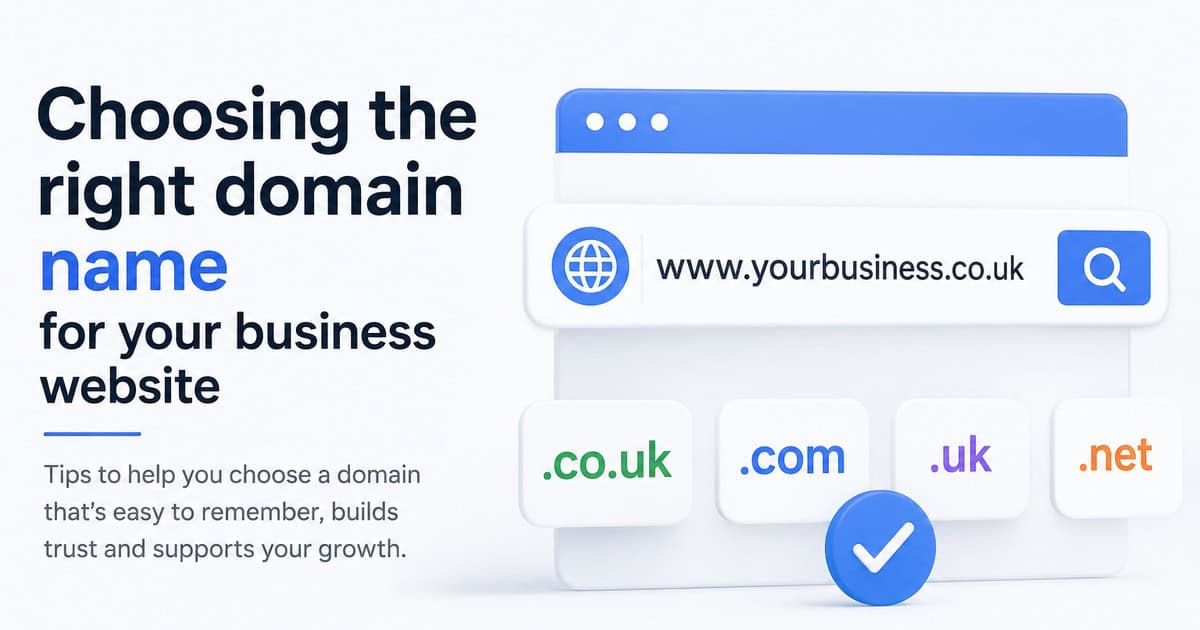
The domain extension is the ending of the domain, such as .co.uk, .uk, .com, .org or .net.
For UK small businesses, .co.uk is still widely recognised and trusted. It immediately tells people that the business is UK-based, which can be useful for local and regional service businesses. The shorter .uk extension is also common, although many people still instinctively recognise .co.uk as the more familiar business option.
A .com domain can also work well, especially if you trade internationally, sell online beyond the UK or want a broader brand feel. The challenge is that .com domains are often harder to secure because so many have already been registered.
Other extensions, such as .org, .digital, .studio, .agency, .shop or local extensions, can sometimes make sense, but they should be chosen carefully. Some can feel modern and relevant. Others may be less familiar to your audience, which can make the domain slightly harder to remember.
The right choice depends on how your business wants to be understood. A local trades business may benefit from a clear .co.uk. A creative studio may have more flexibility. A charity may naturally suit .org. An ecommerce brand may want to secure both .co.uk and .com if available.
The extension should support trust, not just availability.
Do keywords matter in a domain name?
This is where many business owners get stuck.
Years ago, people often tried to choose domains packed with keywords because they believed it would help them rank more easily. You still see examples like bestplumbertamworth.co.uk or cheapwebdesignservicesuk.co.uk. The problem is that domains like this can feel generic, limiting and sometimes less trustworthy.
A keyword in a domain can be useful if it naturally fits the business name or helps people understand what you do. For example, a domain that includes “joinery”, “accountants”, “design”, “florist” or “therapy” can provide useful clarity. But it should not come at the expense of brand quality.
Search performance depends on much more than the domain name. Your website structure, content quality, local SEO, technical setup, page speed, backlinks, Google Business Profile, reviews and overall usefulness all matter. A keyword-heavy domain will not rescue a weak website, and a strong brand domain will not hold back a well-built, useful website.
For most small businesses, the best domain is usually one that balances brand recognition with clarity.
Check for conflicts before you commit
Before registering a domain, it is worth doing a few basic checks.
Search the name on Google. Look at social media platforms. Check whether similar businesses are already using the name. If you are building a serious brand, check trademarks through the UK Intellectual Property Office and consider whether the name could create confusion with another business.
This is not just a legal consideration. It is also a practical one.
If another business with a very similar name already dominates search results, social media handles and domain variations, you may spend a lot of time fighting for recognition. If they operate in the same industry, the problem becomes even bigger.
A domain name should give your business room to build its own identity. If the name is already crowded, it may be worth adjusting before you invest in a website, branding, signage, content and marketing.
Think about email as well as the website
Your domain name is not only your website address. It is also likely to become part of your email address.
That means it needs to look professional in a business context. An email address such as [email protected] or [email protected] immediately feels more established than a free personal email address. It reassures people that they are dealing with a proper business, not just a loose online presence.
When choosing a domain, imagine how it will look after the @ symbol. Is it too long? Does it feel credible? Is it easy to read? Would it look professional on an invoice, proposal or quote?
These details may seem small, but they contribute to the overall trust picture. A domain name can help your business look more organised before anyone has opened your website.
Consider buying sensible variations
Once you have chosen your main domain, it may be worth securing obvious alternatives.
For example, if you choose the .co.uk version and the .com is also available, buying both can prevent confusion later. You may also want to secure the .uk version. These additional domains can usually be redirected to your main website, so visitors still arrive in the right place.
This does not mean you need to buy every possible variation. That quickly becomes unnecessary and expensive. The aim is to protect the most obvious versions people might type or competitors might register.
For a local business, securing the main domain and one or two sensible alternatives is often enough.
Do not choose only for today
A domain name should fit your business now, but it should also give you room to grow.
If your domain is too specific, it may become limiting. For example, a business that starts with one service may later expand into wider support. A location-based domain may work well if you only ever want to serve one area, but it can become restrictive if you grow beyond that. A product-specific name may feel useful at launch but awkward if your offer changes.
That does not mean every domain has to be broad. A clear niche can be powerful. But it is worth asking whether the domain still makes sense if your business develops.
A good domain should support the next stage of your business, not trap you in the first version of it.
What if your ideal domain is taken?
This is common, especially for businesses with simple or familiar names.
If your ideal domain is unavailable, do not panic and do not immediately choose the nearest awkward version. Step back and look at your options.
You might add a relevant word that clarifies the business, such as “studio”, “design”, “services”, “group”, “online”, “consulting” or your location if it genuinely helps. You might use a shortened version of your business name. You might choose a different extension if it still feels credible. You might adjust the brand name slightly if you are still early enough in the process.
The key is to avoid a domain that feels like a compromise every time you use it.
If the available option is long, clumsy, hard to spell or too similar to another business, it may cause more problems than it solves.
A good domain name supports the whole website
Choosing the right domain name is not about finding a magic formula. It is about making a decision that supports recognition, trust and usability.
Your domain should help people find you, remember you and feel confident that they are in the right place. It should sit comfortably alongside your brand, your email, your social profiles, your search presence and your future marketing. It should feel clear enough for visitors and flexible enough for your business.
The best domain names tend to feel simple once they are chosen. They do not draw attention to themselves for the wrong reasons. They quietly support the business behind them.
That is often what good website decisions do. They reduce friction. They make the next step feel easier. They help visitors move from uncertainty to confidence.
If you are planning a new website and are unsure which domain name makes sense, Expand Digital Media can help you look at the options clearly before you commit. The right choice at the start can make the rest of your digital foundation feel much easier to build.
